
journal no. 02notes
traveling privately with your dog
The appeal is simple. The dog stays beside you. No hold. No carrier pressed beneath a seat. The terminal is smaller, the waiting shorter, the day your own.
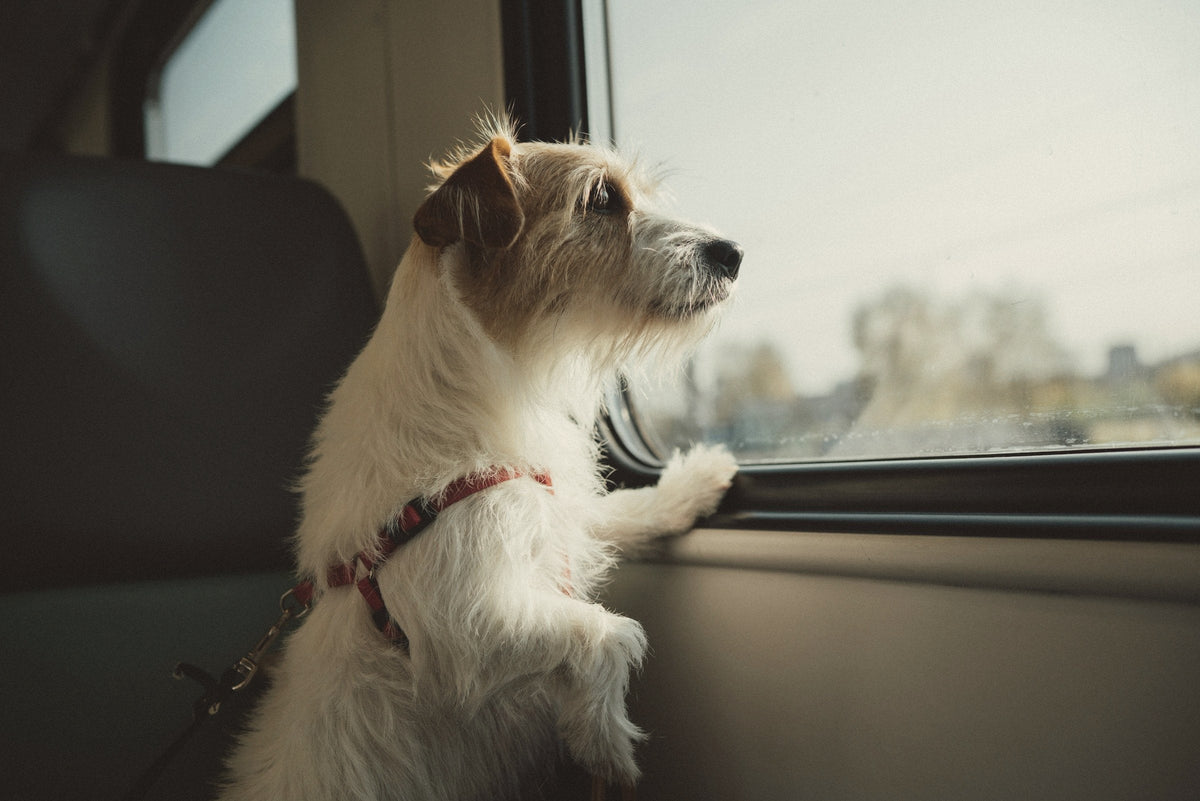
The appeal is simple. The dog stays beside you. No hold. No carrier pressed beneath a seat. The terminal is smaller, the waiting shorter, the day your own.
Private aviation changes how a dog travels. It does not change whether a dog may enter a country. That distinction is the whole of this guide.
the commercial baseline
It helps to understand what private flight replaces.
On commercial airlines, the US Federal Aviation Administration leaves it to each airline to decide whether pets may travel in the passenger cabin, and some airlines allow none (FAA). The US Department of Transportation notes that many carriers restrict size and weight, often require the pet to fit in a carrier under the seat in front, and may restrict cargo travel in hot or cold seasons (US Department of Transportation).
A representative example: Delta's published policy for cabin pets requires the kennel to fit under the seat directly in front, recommends a soft-sided kennel no larger than 18 x 11 x 11 inches, allows one kennel per customer, and keeps the pet inside it on board (Delta Professional). For a small dog, this can work. For a retriever, it cannot.
who makes the rules in the air
On a private aircraft, the operator does.
There is no federal rule requiring private operators to accept pets, and no rule prescribing how pets are handled in the cabin. Acceptance rests on the operator's policy and the pilot in command's authority over the safe conduct of the flight under 14 CFR 91.3 (Lookbook and Fly). Several fractional and membership programs publish pet programs of their own. For a one-off charter, pet terms sit in the charter agreement and can vary by aircraft, and the aircraft owner may have the final say (Lookbook and Fly).
In practice, ask early and ask in writing:
- Is the dog accepted on this specific aircraft, not only by this operator.
- Are there weight, breed or number limits.
- What restraint is expected for taxi, take-off and landing. Operators commonly ask for a carrier, or a harness with the seat belt routed through it, as a matter of operator policy rather than federal rule (Lookbook and Fly).
- Is there a cleaning deposit, and what forfeits it.
Get the answers on the trip sheet. Aircraft size matters too. A large dog fits very differently in a light jet than in a long-range cabin (Lookbook and Fly).
the paperwork does not fly private
Borders treat a dog arriving by private jet as they treat any other. The same health certificates and destination-country rules apply regardless of the aircraft (Lookbook and Fly). Start with the destination, then work back.
Leaving the United States. The destination country sets the requirements. Most require a health certificate issued by a veterinarian who examines the dog and performs or verifies the required tests, vaccinations and treatments (USDA APHIS). APHIS advises contacting a USDA-accredited veterinarian as soon as travel is decided, and building a schedule to meet each time window (USDA APHIS).
Returning to the United States. Since August 1, 2024, all dogs entering the US must appear healthy, be at least six months old, be microchipped, and arrive with a CDC Dog Import Form submission receipt, with further requirements depending on where the dog has been in the previous six months (CDC). For dogs that have been only in dog rabies-free or low-risk countries during that period, the form receipt is the only required documentation (CDC).
Entering the European Union. With some exceptions, a dog needs a microchip meeting EU technical requirements, a rabies vaccination, and, when arriving from most non-EU countries, a rabies antibody titration test (Your Europe). French government guidance notes the rabies vaccine can be given from 12 weeks of age and takes effect at least 21 days later (Service-Public.fr). The microchip must come first, or at the same time as the vaccine (GOV.UK).
Entering Great Britain. Dogs must arrive on approved routes with an authorised carrier (GOV.UK). The government publishes a list of approved charter operators and the airports each may use (GOV.UK). Confirm that your operator and arrival airport appear on it. Dogs also need tapeworm treatment from a vet, given at least 24 hours and no more than five days before arrival, unless coming directly from a small list of exempt countries (GOV.UK).
Hawaii. Hawaii is rabies-free and protects that status with quarantine law. Dogs must complete either the 120-day program or the 5 Day Or Less program, which requires, among other conditions, at least two lifetime rabies vaccinations (Hawaii Department of Agriculture). Plan months ahead.
Keep every document in one place, printed and digital. A slim leather folio is useful here.
the dog, not the aircraft
Comfort in the air begins weeks before it.
Let the dog know the carrier or harness at home. Short car journeys help. On the day, a walk before boarding, a light meal well in advance, water on hand.
Speak to your veterinarian before any sedative. The American Veterinary Medical Association recommends against giving tranquilizers for air travel and urges caution with short-nosed breeds, which may have difficulty flying (AVMA). The AVMA notes that US Department of Transportation figures once showed roughly half of reported airline dog deaths over a five-year period involved short-faced breeds (AVMA). Those figures concern commercial flights, but the underlying physiology travels with the dog. A cool, calm cabin matters.
what to pack
Keep it to what the dog actually uses.
- A familiar blanket or bed that smells of home.
- A collapsible or travel bowl, and water.
- A lead and collar with current identification.
- Any medication, with the prescription.
- Waste bags, a cloth, a small towel.
- Copies of every certificate and form.
on arrival
Ask the operator about the arrival handler and where the dog may be walked. Customs and animal-health checks happen at the private terminal just as they would elsewhere. Have the documents ready, and the lead short.
Then the quieter part. A new room. A bed that smells familiar. The dog settles first, as dogs do.
a note on accuracy
Pet travel rules change, and they differ by origin, destination and the dog's own history. This guide is general information, not legal or veterinary advice. Confirm every requirement with your veterinarian, your operator and the official government sources linked above before you fly.
wagl is an independent house of curation and is not affiliated with any airline, aviation operator or government agency mentioned here.