
journal no. 01notes
the case for a hand-stitched collar
A collar is the one object a dog wears every day. It is touched more than anything else in the house. It meets rain, grass, the hand at the door. It should be made accordingly.
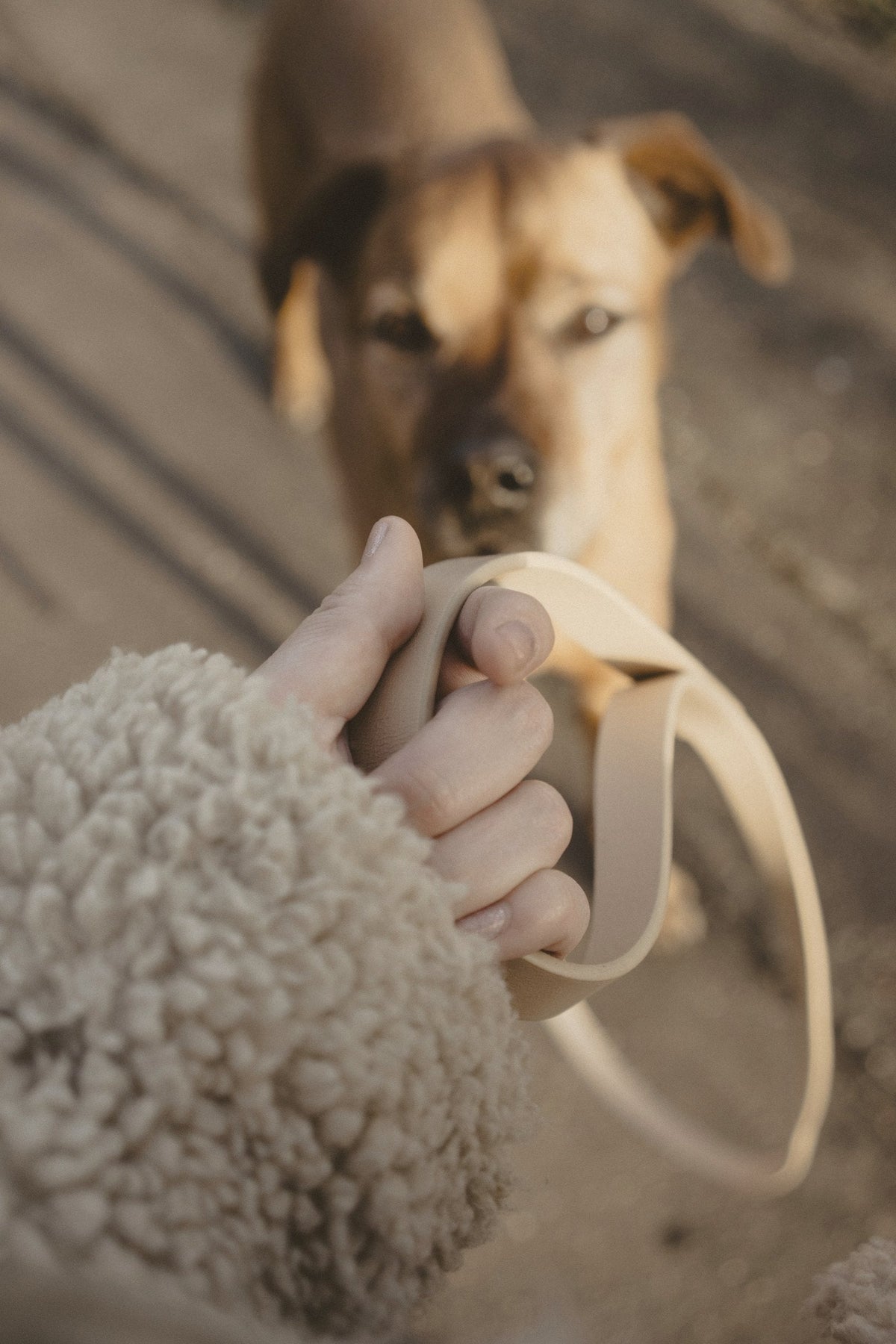
A collar is the one object a dog wears every day. It is touched more than anything else in the house. It meets rain, grass, the hand at the door. It should be made accordingly.
This is a short argument for the slow version. Thread pulled by hand. Leather left whole. Metal that will outlast the season. Not because slowness is a virtue in itself, but because of what it does to the object.
two needles, one thread
Most stitched goods are sewn by machine. A machine lockstitch joins a top thread and a bobbin thread, linked in a chain along the seam. It is fast and even. Its weakness is structural: as leatherworkers explain, a machine lockstitch chains its loops together, so a cut thread can begin to unravel the line (Leathercraft Haven).
The saddle stitch works differently. One waxed thread, a needle at each end. Both needles pass through every hole, from opposite sides, so each stitch crosses and locks inside the leather on its own (Leathercraft Haven). If one stitch is cut, its neighbors hold. Guides to hand stitching describe the same property: the interlocking stitches stay intact even if one thread breaks (Leather Advice).
On a collar, this matters in particular places. Where the leather folds around a ring. Where the buckle is anchored. Where a lead pulls, again and again, at a single point. A seam that holds stitch by stitch is a seam that can be repaired stitch by stitch, too, rather than replaced.
There is also the look of it. A hand-sewn line sits at a slight angle, each stitch leaning into the next. The eye reads it as quiet, regular, alive. It is a small thing. It is visible every time the collar is fastened.
see collars & leads in the edit
leather left whole
The stitch is only as good as the material it passes through.
The phrase "full grain" has a specific meaning. The Leather Research Laboratory cites the industry definition: the grain split of a hide "from which nothing has been removed except the hair and associated epidermis" (Leather Research Laboratory). Nothing sanded away. Nothing corrected. The densest, most tightly woven fibers of the hide remain at the surface, which is where a collar takes its wear.
Leather that has been buffed and coated to hide marks can look uniform on the first day. Full grain looks like itself. Small marks of the animal's life may show. Over time, especially in vegetable-tanned leather, the surface darkens and softens with light and handling into what is called patina (Priestleys). A collar of this kind is meant to change. The change is the point.
the edge
Look at the edge of a collar before you look at anything else.
A cut edge on leather is raw fiber. Left alone, it frays and fuzzes. Well-made goods have edges that are beveled, sanded and burnished, worked with wax and friction until they close and shine. Vegetable-tanned leather takes burnishing more readily than chrome-tanned leather, which is one reason makers choose it for pieces with exposed edges (Gentleman's Gazette).
A rounded, polished edge is also kinder to the neck. Nothing sharp against fur. Nothing to catch.
honest metal
A collar is a load-bearing object. The hardware carries every pull on the lead.
Makers of leather dog collars generally recommend solid cast brass or stainless steel for buckles and rings, with a welded D-ring rather than one bent closed, since the ring carries the force of the lead (Leathercraft Haven). The two metals age differently. Brass warms into a patina of its own. Stainless stays bright (Leathercraft Haven). Either can be right. Plated alloys, by contrast, can wear through at the points of friction, and corroded hardware can mark the leather around it (Volere).
Weight in the hand is a reasonable test. So is the sound a buckle makes as it closes.
a fit that respects the dog
The finest collar is wrong if it fits badly.
The American Kennel Club advises measuring the neck with a soft tape rather than relying on size labels, then checking the fit with two fingers: if two fingers cannot slide underneath, it is too tight; if more slide in easily, it is too loose (American Kennel Club). A collar should also be checked to ensure it cannot slip over the head (American Kennel Club).
There is a quiet honesty in the AKC's guidance on timing, too. Puppies grow quickly in their first year, and the AKC suggests that a more expensive leather collar may not be worth buying for a puppy who will outgrow it in weeks (American Kennel Club). Leather is best kept for the grown dog. Something to look forward to.
the tag, the name, the way home
A collar is also a record of belonging. The AKC describes the collar and ID tag as a first line of defense against losing a dog, and recommends that a dog wear a collar with identification whenever it is safe to do so, alongside a microchip (American Kennel Club).
A well-made tag should be engraved deeply enough to stay legible. It should hang from a ring that will not open. Some owners prefer a name and number stitched or stamped into the collar itself, which the AKC notes as an alternative to a dangling tag (American Kennel Club). Either way, the information should be current.
caring for it
Leather that is worn every day needs very little, done well. Wipe away mud with a soft, barely damp cloth. Let it dry slowly, away from radiators and sun. One caution specific to dogs: the AKC advises against using furniture or shoe leather cleaners on a collar, since their chemicals can be toxic to dogs (American Kennel Club). Choose products made for the purpose, and use them sparingly. Our longer note on caring for fine leather goods covers the rest.
why it is worth it
A hand-stitched collar is not a statement. It is a decision about how an everyday thing should be made. Stitches that hold one by one. Leather that keeps its full surface. Metal that does not flake. An edge that has been finished by hand.
None of this announces itself. It simply lasts, and softens, and becomes particular to one dog.
That is the case. Quietly made.
wagl is an independent house of curation and is not affiliated with any maker, brand or organization mentioned here. The makers and materials described here are discussed for information only.